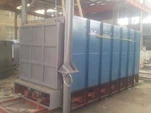
The bellows annealed by the bell annealing furnace has good plasticity, but the yield strength and tensile strength drop slightly. In all processes, the action of hydrogen is the strong circulating medium and the purging strip for the heating and cooling of the strip. Surface residue. The residue on the strip surface is mainly from the cold rolling process, followed by the coiling of the steel coil, entrained inside the coil. The cold-rolled product is usually not degreased after cold rolling, and is directly exposed to the inside of the bell annealer for bright annealing. The emulsion remaining on the surface of the steel sheet is definitely removed, and the usual method is to use offline or perhaps Online degreasing treatment, perhaps annealing to remove the dirt on the plate. However, if the emulsion is removed by annealing, the annealed steel coil usually has a black strip condition, which affects the surface quality.
Then what is the reason for the occurrence of steel coil black belt in the annealing of the hood annealing furnace? How to deal with such a situation? Let's take a look at it with Suzhou Qiao's Cover Furnace Co., Ltd.
At the initial stage of annealing and heating, the rolling oil inside the surface emulsion of the steel strip is volatilized by heat, and as the temperature rises, some of the rolling oil that does not follow the hot gas is pyrolyzed, and if it is insufficient, it is blown off. It will precipitate on the surface of the steel strip inside the cooling process and cause carbon black.
At the beginning, as the temperature rises, the moisture inside the residual steel emulsion begins to evaporate (up to 100 degrees Celsius), and the residual emulsion on the surface of the steel sheet begins to be sold and decomposed (up to 300 degrees Celsius). The hydrocarbon first reacts with the oxygen inside the water vapor, causing carbon monoxide between the ring and the ring of the steel strip. Following the temperature rise, the long chain initiates cracking, causing the atomic group, and the small hydrogen molecules are between the steel strips. The control is simply dispersed, and the open ends of these radicals are in a hydrogen saturation stage, resulting in a simple volatile light hydrocarbon. At this time, hydrogen is good for restoring carbon deposits, and some carbon will remain on the surface of the steel plate. At 700 degrees Celsius, hydrogen will directly react with carbon deposits to form methane. Therefore, the goal of hydrogen purging is to replace the emulsion volatilized on the surface of the coil during heating in the furnace.
So how do we deal with the black belt problem of the coil? The original method of handling is very simple, and it is only necessary to improve the purge rail system of hydrogen.
Regarding some ordinary CQ steels, the heating speed is not limited from the mechanical function, and it is possible to carry forward the potential of the equipment. In the essential manufacturing process, the heating rate is 60 to 100 degrees Celsius per hour, and the heating temperature is 680 degrees Celsius. According to the characteristics of the hood annealing furnace equipment and the characteristics of the rolling mill rolling oil, the large-flow hydrogen blowing temperature starts at 450 ° C. According to the above analysis, the following hydrogen purging rail is used to make the following hydrogen purging rail system.