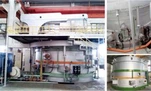
Clean heat treatment
Waste water, waste gas, waste salt, dust, noise and electromagnetic radiation from heat treatment production will cause pollution to the environment. To solve the environmental pollution of heat treatment and to implement clean heat treatment (or green heat treatment) is one of the development directions of heat treatment technology in developed countries. In order to reduce the emission of SO2, Co, CO2, dust and cinder, the use of coal as fuel has been basically eliminated, and the use of heavy oil is becoming less and less. The majority of light oil is used, and natural gas is still the most ideal fuel.
The waste heat utilization of combustion furnace has reached a high level. The optimization of burner structure and strict control of air-fuel ratio ensure the reasonable combustion and minimize NOx and Co. gas carburizing, carbonitriding and vacuum heat treatment technology are used instead of salt bath treatment to reduce the pollution of waste salt and CN containing toxic substances to water source. Water soluble synthetic quenching oil is used instead of partial quenching In order to reduce oil pollution, bio degradable vegetable oil is used instead of some mineral oil.

Precision heat treatment
Precision heat treatment has two meanings: on the one hand, according to the use requirements of parts, materials, structural dimensions, using the knowledge of physical metallurgy and advanced computer simulation and detection technology, optimizing process parameters to achieve the required performance or maximize the potential of materials; on the other hand, fully ensuring the stability of optimization process and realizing the small dispersion of product quality( Or zero) and heat treatment distortion is zero.
Energy saving heat treatment
Scientific production and energy management are the most potential factors for the effective utilization of energy. The choice of scientific management is to establish a professional heat treatment plant to ensure full load production and give full play to equipment capacity. In terms of energy structure of heat treatment, primary energy is preferred; waste heat and waste heat are fully utilized; processes with low energy consumption and short cycle are used instead of those with long cycle and large energy consumption.