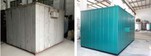
The structure of the trolley-type annealing furnace, heating technology, temperature control and furnace atmosphere will directly affect the quality of the processed product. In the casting furnace, the heating temperature of the metal is improved, and the deformation resistance can be lowered. However, if the temperature is too high, the grain growth, oxidation or over-burning may occur, which seriously affects the quality of the workpiece. In the heat treatment process, if the steel is heated to a certain point above the critical temperature and then suddenly cooled, the hardness and strength of the steel can be improved; if it is heated to a certain point below the critical temperature and then slowly cooled, the hardness of the steel can be increased. Decline and make the toughness progress.
In order to obtain a workpiece with accurate dimensions and smooth appearance, or to reduce metal oxidation to protect the mold and reduce the machining allowance, various less oxidation-free furnaces can be selected. In the open flameless oxidation-free heating furnace, the incomplete incineration of the fuel is used to generate a restorative gas, and heating the workpiece therein can reduce the oxidation loss rate to 0.3% or less.
The controlled atmosphere furnace is a manually prepared atmosphere. It can be subjected to gas carburizing, carbonitriding, bright quenching, normalizing, annealing and other heat treatments in the furnace: to achieve the purpose of changing the metallographic arrangement and improving the mechanical properties of the workpiece. In the active particle furnace, the incineration gas of the fuel, or other fluidizing agent applied externally, forcibly flows through the graphite particles or other lazy particle layers on the hearth, and the workpiece is buried in the particle layer to complete the intensive heating. Various non-oxidative heating such as carburizing and nitriding. In the salt bath furnace, the molten salt solution is used as a heating medium to prevent oxidation and decarburization of the workpiece. Casting of cast iron in a cupola is usually affected by conditions such as coke quality, air supply method, charge condition and air temperature, making the smelting process difficult to stabilize and difficult to obtain high-quality molten iron. The hot air cupola can effectively improve the temperature of the molten iron, reduce the burning of the alloy, and reduce the oxidation rate of the molten iron, so that high-grade cast iron can be produced.

The fuel of the flame furnace has a wide history and low price. It is convenient for tailoring to adopt a different structure, which is conducive to lowering the production cost. However, the flame furnace is difficult to complete accurate control, and the environmental pollution is severe and the thermal efficiency is low. The electric furnace is characterized by uniform furnace temperature and easy to complete active control, and the heating quality is good. According to the energy conversion method, the electric furnace can be further divided into an electric resistance furnace, an induction furnace and an electric arc furnace. The furnace heating capacity calculated by the bottom area of the unit time unit is called the furnace yield. The faster the furnace is heated and the larger the furnace load, the higher the furnace yield. In general, the higher the furnace yield, the lower the unit heat cost per kilogram of material heated. Therefore, in order to reduce the energy consumption, it should be produced at full capacity, try to improve the furnace yield, and implement the active share adjustment of fuel and combustion air to the incineration equipment to prevent excess or lack of air. In addition, it is necessary to reduce the heat storage and heat loss of the furnace wall, the heat loss of the water-cooled components, the loss of radiant heat of various openings, and the loss of heat from the flue gas.
The ratio of the heat absorbed by a metal or material as it is heated to the heat supplied to the furnace is called the furnace thermal efficiency. The continuous furnace has higher thermal efficiency than the intermittent furnace. Because the continuous furnace has high yield and is uninterrupted, the furnace heat system is in a stable state, there is no periodic furnace wall heat storage loss, and because there is a furnace inside. In the section of the preheating charge, some residual heat of the flue gas is because there is a section of the preheating charge inside the furnace, and some residual heat of the flue gas is absorbed by the cold workpiece entering the furnace, and the temperature of the flue gas from the furnace is lowered.