In the Shang Dynasty, China has developed a relatively perfect copper smelting furnace, with furnace temperature reaching 1200 ℃ and furnace inner diameter of 0.8m. In the spring and autumn and Warring States period, people further grasped the technology of improving furnace temperature on the basis of melting copper furnace, and produced cast iron.
In 1794, the world presented a straight tube Cupola for smelting cast iron. Later, in 1864, Martin, the French, used the principle of Siemens, the British, to create the first steel-making flat furnace heated with gas fuel.
He preheat air and gas at high temperature by using a heat storage chamber, thus ensuring the temperature of more than 1600 ℃ required for steelmaking. Around 1900, the power supply gradually enough, began to use various resistance furnaces, arc furnaces and cored induction furnaces.
In the 1950s, coreless induction furnaces were developed rapidly. Then, the electron beam furnace was presented, which can strengthen the external heating and melting of high melting point materials by using electron beam to impact solid fuel. The furnace used for casting heating was first hand forging furnace, and its working space was a concave groove, which was filled with coal.
The air for incineration was supplied from the lower part of the tank, and the workpiece was buried in coal for heating. The furnace has low thermal efficiency and poor heating quality. It can only heat small-sized workpieces. Later, it will be developed as a semi closed or fully closed chamber furnace made of fire-resistant bricks. It can use coal, gas or oil as fuel, and electric power as heat source. The workpieces are heated in the furnace.
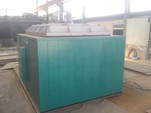
In order to heat large workpiece easily, a trolley furnace suitable for heating ingots and large billets is presented, and well furnace is also presented for heating long rod parts. After 1920s, there are various mechanized and active furnace types which can improve the furnace production rate and improve the working conditions.
The fuel of trolley type furnace also follows the development of fuel resources and the progress of fuel conversion technology. Instead of using solid fuels such as lump coal, coke and pulverized coal, the fuel gas, urban gas, natural gas, diesel oil, fuel oil and other gas and liquid fuel are gradually used, and various incineration equipment suitable for the fuel used has been developed.
The structure, heating technology, temperature control and atmosphere in the furnace of trolley type furnace will directly affect the quality of the products after processing. In the casting furnace, the metal heating temperature can be improved to reduce the deformation resistance, but the high temperature will cause grain growth, oxidation or over burning, which seriously affects the quality of the workpiece.
In the process of heat treatment, if the steel is heated to a point above the critical temperature and then cooled suddenly, the hardness and strength of the steel can be improved; if it is cooled slowly after heating to a point below the critical temperature, the hardness of the steel will decrease and the toughness will be improved.
In order to obtain the workpiece with accurate scale and smooth appearance, or to reduce metal oxidation to protect the mold and reduce machining allowance, various kinds of non oxidation heating furnaces can be selected.
In the open flame less oxidation free furnace, recovery gas is produced by incomplete burning of fuel. The burning loss rate of oxidation can be reduced to less than 0.3% by heating the workpiece.
Controlled atmosphere furnace is a kind of atmosphere prepared by manual. It can be used for heat treatment such as gas carburizing, carbon nitrogen co carburizing, bright quenching, normalizing and annealing in order to change the metallographic arrangement and improve the mechanical properties of the workpiece.
In the active particle furnace, the burning gas of fuel or other fluidizer applied externally can be forced through graphite particles or other lazy particle layers on the furnace bed. The workpiece embedded in the particle layer can be used to strengthen heating, and various non oxidation heating such as carburizing and nitriding can be carried out. In salt bath furnace, molten salt solution is used as heating medium to prevent oxidation and decarbonization of workpiece.
The melting of cast iron in cupola is usually affected by coke quality, air supply method, charge condition and air temperature, which makes the smelting process difficult to be stable and difficult to obtain high-quality molten iron. Hot blast cupola can effectively improve the temperature of molten iron, reduce the alloy burn loss and reduce the oxidation rate of molten iron, thus producing high-grade cast iron.
With the appearance of coreless induction furnace, cupola has a tendency to be replaced gradually. The smelting operation of this induction furnace is not limited by any grade of cast iron, and it can be quickly converted from smelting one grade of cast iron to smelting another, which is conducive to the improvement of the quality of molten iron.
Some special alloy steels, such as ultra-low carbon stainless steel and rolls and turbine rotors, need to melt the molten steel from flat furnace or general arc furnace, and then mix them in the refining furnace by vacuum degassing and argon gas agitation, and further refine high purity and high-quality steel with large capacity.
The flame furnace has a wide range of fuel sources, low price, easy to tailor different structures, which is conducive to reduce production costs. However, it is difficult to complete accurate control of the furnace, which is very serious to the environment and low in thermal efficiency. The characteristics of electric furnace are uniform temperature, easy to complete active control and good heating quality. According to the energy conversion method, electric furnace can be divided into resistance furnace, induction furnace and arc furnace.
The furnace heating capacity calculated by unit time unit area of furnace bottom is called furnace yield. The faster the furnace temperature rise and the larger the load, the higher the furnace yield. In general, the higher the furnace yield, the lower the unit heat consumption per kilogram of material.
Therefore, in order to reduce energy consumption, full load production should be carried out, and the furnace production rate should be improved as far as possible. The active share adjustment of fuel and combustion air shall be carried out for incineration equipment together to prevent excess air or lack of air.
In addition, the heat storage and heat loss of furnace wall, heat loss of water cooling components, radiation heat loss of various openings, heat loss from flue gas from furnace, etc. should be reduced.
The ratio of heat absorbed by metal or material to the heat supplied into the furnace is called furnace thermal efficiency. The continuous furnace has higher thermal efficiency than the intermittent furnace, because the continuous furnace has high production rate and is continuously operated.
The furnace heat system is in a stable state, and there is no periodic heat storage loss of furnace wall. In addition, there is a preheating section in the furnace. Some residual heat of flue gas is because there is a preheating furnace charge section inside the furnace, and some residual heat of flue gas is input The temperature of flue gas from the furnace is decreased by absorption of the cold workpiece of the furnace.
To complete the active control of furnace temperature, furnace atmosphere or furnace pressure.